

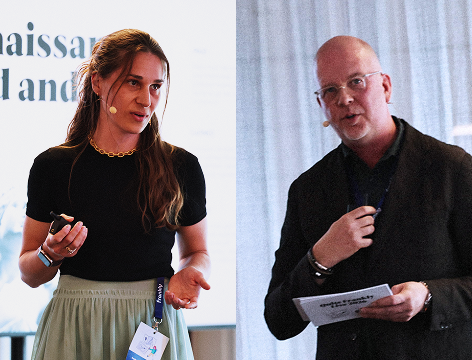
- Speaking bluntly, the CMO used to be more or less a campaign manager, Klavs Valskov, Partner at the creative digital agency Frankly, says.
In his experience, the marketing director's role has undergone a significant transformation in recent years.
Where the job once revolved largely around campaigns, creative development, and product launches, modern marketing directors are now expected to play a far broader role across the organisation.
At the same time, AI and new digital technologies have expanded both the possibilities and the complexity.
- The CMO was supposed to push something creative out into the market. A new service, for instance. And everything was directly dictated by sales:
“Here are the product launches, here are the sales targets. Now, make something happen!”
But a great deal has changed in recent years, he believes.
- While the role of the CMO has become much more complex, it also has the potential to become even more important across the business. Not least as a consequence of the opportunities — and challenges — that AI has brought with it, Klavs Valskov says.
- As a CMO today, you need to ensure that brand strategy, creative development, and digital solutions converge. At the same time, it no longer makes sense to simply blast out communications with a scattergun approach, as was often the case before. It's not an easy task, he adds.
According to Klavs Valskov, the role of the CMO has shifted from primarily being about creativity to also requiring insight into virtually every corner of the business, from product development to launch.
Johannes Hattula agrees. He is an associate professor and marketing researcher at Copenhagen Business School (CBS).
- Marketing used to be primarily about creativity and intuition. But digital development — and the many different, individualised platforms through which you now need to reach consumers — has made the job much, much more complex, he says.
- Today, CMOs don't just need to be creative and financially literate. They also need to be technically proficient. They need to understand human psychology, but they also need to understand the machines through which they reach those humans.
Johannes Hattula continues:
- To succeed, you need to be able to design the entire customer journey and collaborate with everyone in the business. From product development to sales. It's incredibly complex.
Communicating on two tracks
With the new digital reality, where AI models are increasingly the first point of contact between consumers and a product, the challenge in communication has also become far more complicated, says Johannes Hattula.
In his view, modern CMOs fundamentally need to communicate on two separate tracks.
- As a CMO, you no longer only target the people you're trying to reach. You also have to address the AI agents that, in many cases, will convey your message to the customer, he says.
- Therefore, companies need to be able to communicate emotionally to consumers if they want to attract them to their brand, while simultaneously communicating in a clear, factual way to machines. In a language that machines understand and can translate for consumers in the intended way. Again: it's very complex.
At Grundfos, too, the marketing function has changed significantly in recent years. That development has required changes to the team's composition, driven by an increasingly complicated path to customer attention.
So explains the company's CMO, Kenth Hvid Nielsen.
- We've moved from broad product positioning to showing why our solutions make a real difference for the individual customer. Competition is so fierce today, and we all look alike. So if we can't clearly explain why choosing us is the right decision, we simply won't sell anything.
A development that has simultaneously increased the need for business understanding, he says.
- The CMO today has a business role to a greater extent than before. We need to understand the business, generate sales, and help drive growth. We help ensure the company meets its commercial objectives. This means business acumen is an absolutely essential prerequisite for a modern CMO.
The partnership with the CTO becomes critical
If marketing directors want to succeed in adapting to the new reality, their collaboration with the company's technology director will be paramount, says Klavs Valskov.
- As a modern CMO, you need to be the one who owns the intelligent, digital customer experiences around the company's brand. To do that, you have to work closely with the CTO or CIO, he says.
He also stresses the importance of CMOs themselves possessing technological understanding.
- A CMO needs sufficient technological literacy to have a handle on data management. It doesn't have to be at a programmer level, but even if you're a little tech-averse, some of the AI tools available can help you gain important insights. You simply have to take advantage of them.
The great divide between human and machine
In marketing circles, there is currently a degree of anxiety about what AI will mean for future marketing departments, Johannes Hattula observes. Will the new technologies make them redundant?
Ask Lerke Christoffersen, Head of Brand at Frankly, and the focus should be on the opportunities above all.
- AI shouldn't be fought. As a CMO, you can only use it as an accelerator. Just like everyone else. AI should prompt you to make even better decisions, faster, she says.
At the same time, she doesn't believe machines will ever fully replace humans in the areas that define a brand's identity.
- To build genuine belonging to your brand among consumers, you still need to ensure its originality and authenticity. At Frankly, we still believe enormously in the idea that human creativity will remain absolutely decisive in the long run. Things need to feel personal for customers to connect. It can't come across as automated and generic.
Lerke Christoffersen points to one difference above all others.
- The truly fundamental difference between a human designer and an AI agent is the originality of the frame of reference. An AI agent's frame of reference will always consist of what has already been established. That makes it impossible for it to be genuinely original.
Johannes Hattula echoes that view.
- It will remain the CMO's role to bring originality, creativity, and intuitive appeal to the equation. That will still be the factor that differentiates individual brands. When everyone is using AI, how do you stand out? Through human originality.
- And then there's the question of where the company's products and brand should be heading in the long term, and what the creative vision for that looks like. I still don't think AI can handle that adequately. The strategic role will likely become even more critical for CMOs in the long run.
The need for a clear strategic direction makes the ability to stay close to customers and understand the market in real time even more important, Kenth Hvid Nielsen believes.
- I invest a lot of energy in being out in the world, close to customers, close to the market. That has always mattered, but I think developments in recent years have made many people extra aware of it. In the past, perhaps we took it somewhat for granted that we had a voice out there. We can't do that anymore.
Courage will be necessary
If Klavs Valskov were to give one piece of advice to CMOs and companies, it centres on that most fundamental of virtues: courage.
- We clearly see a kind of paralysis in a lot of places right now. These are big decisions that need to be made, and you have to be willing to redefine the organisation and challenge existing structures. That takes courage. But that courage will be necessary, because waiting too long could become dangerous.
Meanwhile, Johannes Hattula sees opportunity in the uncertainty many are experiencing right now.
- You can view the uncertainty as a disadvantage. But on the other hand, marketing is a wide-open territory right now. There are potentially many exciting opportunities waiting to be seized, and the winner will naturally be whoever grabs them.