


Most brands have started thinking about AI search. Fewer have thought about AI as a channel - something with its own mechanics, its own levers, and its own version of the question: are you in the conversation or aren't you?
The distinction matters. A channel isn't just a place where your content might surface. It's a system with rules about how influence works. And AI, it turns out, has three distinct areas where brands can build that influence — each operating differently, each rewarding different things.
This piece explains the model and walks through each lever. It's intended to be practical: enough technical depth to make sense of what's actually happening, without the jargon that makes most AI content unreadable.
How an AI answer is actually assembled
Before you can influence an AI answer, you need to understand how one gets built.
When someone asks an AI assistant a question — which supplier to use, which product fits a specific application, who the credible voices are in a given category — the response isn't retrieved from a database or pulled from a ranked list. It's generated. Assembled, in real time, from multiple sources combined into a single coherent answer.
The framework behind most AI search tools is called Retrieval-Augmented Generation, or RAG. It works in three stages: the AI parses what's actually being asked, retrieves relevant material from available sources, then synthesises that material into a response — citing what contributed most.
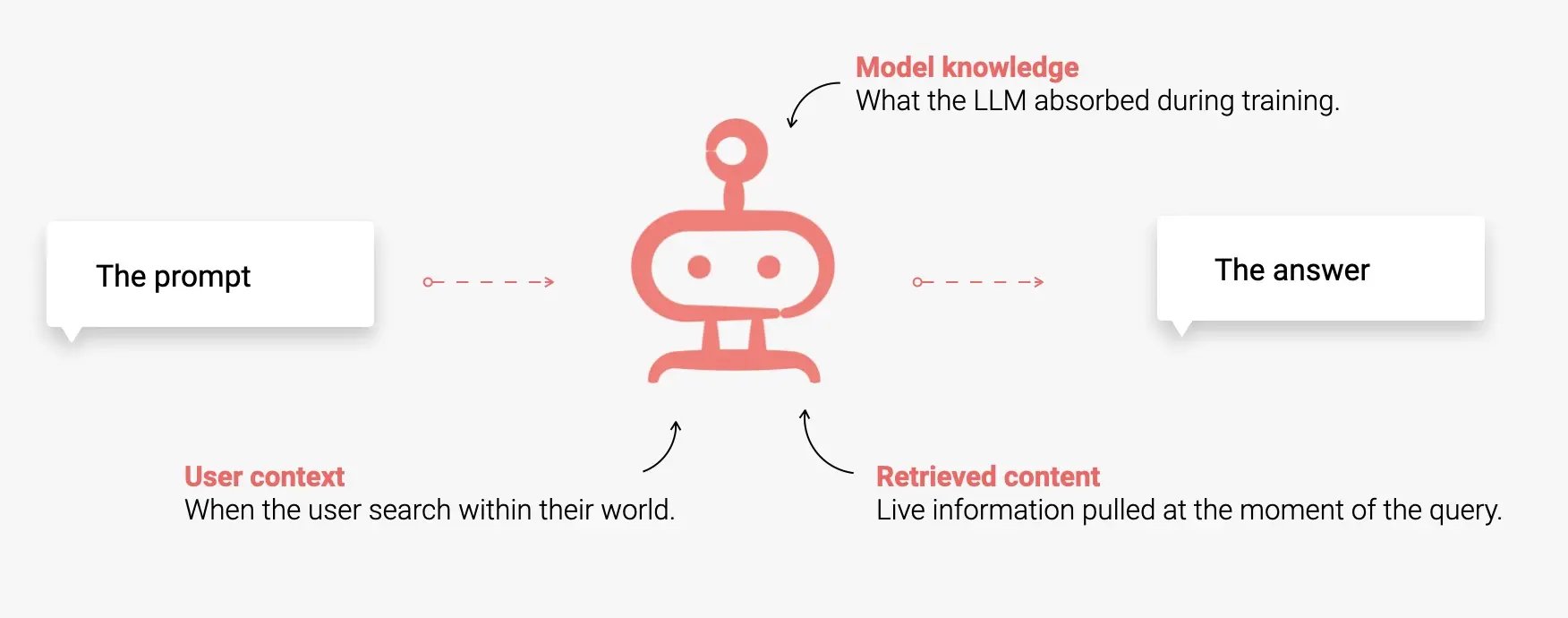
The sources it draws from fall into three distinct categories. And those three categories map directly to the three levers where brands can act.
Trained knowledge is what the model absorbed during its development — articles, documentation, forum discussions, published research, product information. This is the model's baseline understanding of your category. It doesn't update in real time, but it shapes how the AI frames every answer it gives.
Retrieved content is pulled live at the moment of the query — your website, your published articles, your product pages. This is where most brand attention currently sits.
User context is the most recent addition, and the least understood. It's the information available in the specific user's AI environment — their connected tools, company systems, previous interactions. The most personalised layer, and the closest to the moment of decision.
An AI answer is always some combination of all three. Which means each one is an opportunity.
Lever 1: retrieval — GEO and the new rules of visibility
This is the lever most brands have heard of, and the one with the most immediate, actionable surface area.
Google's AI Overviews now appear in 57% of long-tail queries and reach 1.5 billion users monthly. ChatGPT Search processes between 250 and 500 million queries every week. Across all Google searches, 43% now end without a single click to an external site — a figure that rises to 93% when Google's AI Mode is active. Being cited in the answer has become more important than ranking for the click.
Generative Engine Optimisation — GEO — is the discipline of structuring content so AI systems find it, trust it, and use it when assembling responses.
The rules differ meaningfully from traditional SEO. Classic SEO rewarded signals: keyword density, backlinks, domain authority. These still matter as trust indicators, but they no longer determine what gets cited. What determines citation is whether your content directly answers the question being asked — with specificity, structure, and verifiable claims.
Content with cited statistics and named sources achieves 30–40% higher AI visibility than unoptimised content. FAQ-structured pages, precise headers, and content organised around specific questions rather than broad topics all increase the likelihood of retrieval. AI systems don't reward vague. They reward precise.
A practical starting point: take the three questions your customers ask most before making a purchasing decision and search for them in ChatGPT or Perplexity. If your brand doesn't appear, you're invisible for those queries. Look at what does appear — and reverse-engineer why.
The brands with a genuine head start here are the ones that have been producing specific, authoritative content for years. The adjustment is mostly structural: making sure that substance is formatted for machine consumption, not just human reading.
Lever 2: learned knowledge — shaping what the model already knows
This lever is slower. It's also more durable.
The models don't update in real time. What they know about your category — which brands are credible, which problems are worth solving, which thinking is authoritative — was shaped by what was published, cited, and validated before their training cutoff. And the next generation of models will be shaped by what exists now.
This is the long game, and most brands aren't playing it deliberately.
The mechanism is straightforward: AI models learn from content that gets referenced. Not content that ranks, or content that converts — content that gets cited by other sources, quoted in industry publications, linked to in forums, used as a reference point by people who write about your category. The more your content shows up as a source in other people's thinking, the more it becomes part of how the model understands your space.
A brand that has spent years publishing genuinely useful material — the kind that explains how to solve hard problems with specificity and honesty, that acknowledges trade-offs rather than hiding them — gradually becomes part of the model's baseline understanding of what good looks like in that category. Not through keyword tactics. Through the kind of content that earns reference.
The inverse is equally true. A brand whose published output consists mostly of product specs and company announcements has given the model very little to learn from. It may show up in retrieval. It probably isn't shaping the model's understanding of the category at all.
The practical implication: the content strategy question isn't just "will this rank?" It's "would another expert cite this?" If the answer is no, it's unlikely to build learned influence regardless of how well it performs in traditional search.
This is slow. Building domain authority was slow too. The brands that started early have something the ones who started late can't buy.
Lever 3: user context — MCP and presence at the moment of decision
This is the least talked-about lever, the least understood, and — for most categories — the least crowded.
Model Context Protocol (MCP) is an open standard introduced by Anthropic in November 2024 that lets AI assistants connect to external data sources and tools in real time. It's the infrastructure that allows an AI to move beyond searching the web and start operating within a specific user's environment — their company systems, their approved vendor databases, their order history, their connected applications.
Adoption has moved fast. By March 2026, MCP downloads had reached 97 million per month — a 970x increase in 18 months. OpenAI and Google DeepMind have both adopted the protocol. Gartner projects that 65% of enterprises will adopt MCP or equivalent standardised AI protocols by the end of 2026, up from 12% in early 2025.
For brands, the implication is a fundamentally different kind of presence.
Consider the scenario: a procurement manager is evaluating suppliers for a technical component. She's working inside an AI assistant connected to her company's ERP, her approved vendor database, and her team's previous order history. She types her question. The AI doesn't search the web — it searches her world.
If your brand has an MCP connection that puts your product catalogue, your technical documentation, your pricing, your compatibility specifications directly into that environment, you're in the answer. Not because you ranked higher. Because you're already in the room.
If you don't, you aren't.
The app store analogy is useful here. In the early days of mobile, the brands that built apps when distribution was cheap and audiences were forming got reach that took competitors years and significant spend to replicate. MCP is that moment, for AI assistants. The infrastructure is forming. The integrations being built now will compound.
For most B2B brands, this means three things: publishing an API that exposes product and documentation data in a machine-readable format; developing MCP server connections that let AI assistants query that data directly; and identifying which AI environments their customers are actually building workflows inside — because that's where the integration needs to live.
The brands that do this won't just show up in search results. They'll show up in the moment the decision is being made, inside the tools their customers are already using.
The three levers together
Each lever operates on a different timeline and rewards different investments.
Retrieval — GEO — is the most accessible and produces results on the shortest timeline. The changes are largely structural: how content is formatted, how questions are answered, how claims are grounded. Brands with existing content authority have a head start; the adjustment is mostly about making that authority deeper and machine-readable.
Learned knowledge is the slowest lever and the most compounding. The content being published now shapes what the next generation of models understands about your category. This isn't a quick win — it's an infrastructure investment in how AI will think about your space over the next several years.
User context — MCP — is the highest-leverage bet for brands willing to move early. Getting your data into your customers' AI environments creates a form of presence that's genuinely hard to displace, because it becomes part of how those customers work, not just how they search.
None of these replaces the others. They're complementary, and they compound. A brand that builds across all three is present at every layer of the AI answer — from the model's baseline understanding of the category, through live retrieval, to the moment of decision inside the customer's own tools.
That's what treating AI as a channel actually means.