What’s in a name?
How we chose the perfect name for a beloved Icelandic brand’s overarching corporate identity.
By Frankly, November 11, 2025
5 min. reading time
The hardest task
Talk to any of our creative, strategy or branding colleagues and they’ll tell you the same thing: coming up with a name for a new business, campaign, or product is one of the trickiest jobs in a major project. Why? Because a name is so crucially important.
In just a few words (often one) you need to tell a brand’s story.
A name should be memorable, of course, but also emotive. It should connect with an audience, stick in their minds, and embody an entire history, mission and set of values. Ideally, it should also be unique. No biggie.
The numbers game
The process of naming is a bit like Scrabble. You think it’s all about the words, but it’s actually a numbers game, too.
There are over 73 million active trademark registrations out in the world right now. So coming up with something original is fiendishly difficult.
That’s why we have a tightly structured approach to the whole process. One with several rounds of brainstorming and iterating. And while it’s not exactly a science, it does involve mix of number crunching and creative thinking. Bit like Scrabble.
Naming in action
Let’s look at a real-life example. One of our most successful (and satisfying) naming projects:
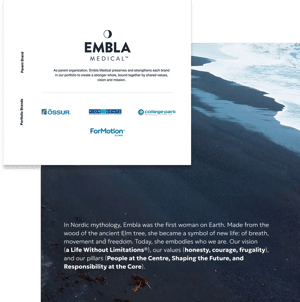
Embla Medical.
The first step
The first, and probably most important, step in the naming process is always research.
So we got stuck into the brief and started looking into every aspect of the brand. Its history, its identity. We interviewed stakeholders and looked at brand guidelines, former campaigns, communications, testimonials… Anything that would give us a better understanding of the brand, its audience and their language.
Once the research was in place. We got into the actual process of brainstorming names.
The process
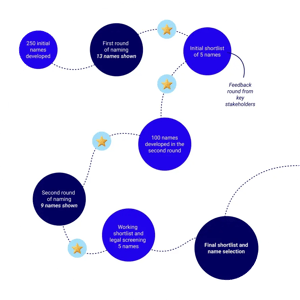
Our naming process looks a bit like this:
As you can see, we come up a with a LOT of names. There’s a reason for this.
No one expects to find the perfect name after one brainstorming session. The idea is to get as many potential names down as possible. Then we start to refine. At each step, we’re looking to tick all the boxes. Not just a nice-sounding name, but everything behind it.
With Embla, this was crucial. As an Icelandic company with a rich heritage, they wanted to celebrate their Nordic identity. And in a way that would express their founding values of strength, compassion, and care.
Nailing it
Sometimes a perfect-sounding name doesn’t hold up under scrutiny. But if we do the work and cover all the bases, eventually, the stars align.
After several mammoth naming rounds, a collaborative back and forth with stakeholders, and thorough legal screening, we landed on Embla.
Stakeholders loved its catchiness. The sound of it. There was something soft about the word, caring. At the same time it projected strength, dependability and trust.
But, most of all, they loved the story behind it.
In Nordic mythology, Embla was the first woman on Earth. Made from the wood of the ancient Elm tree, she became a symbol of new life. Of breath, movement and freedom.
The perfect metaphor for a brand dedicated to improving people‘s mobility with compassion and expertise. One that speaks to both its Nordic heritage and its mission to help people reclaim their freedom.
The power of naming
Embla is a great example of what happens when naming is done right. Once we had a name in place, the rest of the identity grew organically.
A name has the power to shape a brand, from corporate narrative and tone of voice to visual identity and strategic thinking.
This is why we invest so much time, energy, and thought into the naming process. A name is never just a name. It’s a powerful symbol that connects with an audience and opens the door to an entire brand universe.
Complex B2B buyers don’t want persuasion - they want clarity. Discover why calculators, configurators, and self-service tools build trust, shorten sales cycles, and turn your website into a practical utility buyers rely on to make confident decisions.

The interface is now a prompt, not a homepage. AI delivers the answers before anyone reaches your site. That raises a simple question: why have a website at all? Because in a web overrun by machine-made content, human-built sites become rare markers of trust and authority. The website survives, but as something new.

AI is mutating how we create, communicate, and connect. Sure, it brings speed, scale, and endless possibilities to the mix, but it also risks it if left unguarded.